


Marketing Alternatives to College: A Guide for Program Providers
Posted June 2, 2026, 3:56 pm by
Marketing alternatives to college is harder than it looks, and usually not for the reason program providers expect. Your real problem isn't a competitor down the street. It's a default. For most families, a 4-year degree is still the assumed next step after high school, and everything else quietly gets filed under "backup plan." If you run a gap year program, a coding bootcamp, a trade school, a community college pathway, or an internship program, you aren't fighting another program for attention. You're fighting an assumption.
Here's the encouraging part: that assumption is weakening, and the numbers back it up.
Why the demand is already there
The shift toward non-degree paths is real and measurable. Enrollment at vocational-focused community colleges grew nearly 20% between spring 2020 and spring 2025, reaching 871,000 students, according to the National Student Clearinghouse Research Center. Trade school enrollment is projected to grow 6.6% per year through 2030, far outpacing the 0.8% annual growth projected for higher education overall.
The other pathways show the same momentum. Around 90% of students who take a gap year go on to enroll in college within a year, which reframes the gap year as a head start rather than a detour. Coding bootcamps place roughly 71% of graduates in jobs within six months, according to verified data from the Council on Integrity in Results Reporting.
So demand isn't the issue. Families are more open to these paths than they've been in decades. The issue is that most providers still market as if they need to apologize for not being a university.
You're competing with a default, not a rival
When a family considers your program, they usually aren't comparing you to the bootcamp across town. They're comparing you to the idea of college. That single fact should change how you position everything.
You beat a rival on features. You beat a default by reframing the decision itself. The programs that win don't argue that college is a mistake. They make their own path feel like a deliberate, confident choice with its own logic, not a consolation prize for students who couldn't manage the traditional route. That reframe is the foundation everything else is built on.
Three shifts for marketing alternatives to college
1. Reframe what you are
Most providers describe themselves by what they are not. "An alternative to college." "For students who aren't sure about university." Every one of those phrases keeps college as the reference point and signals, however softly, that your program is the lesser option.
The fix is to lead with the destination. A bootcamp isn't "an alternative to a computer science degree." It's "the nine-month path to your first developer job." Same program, completely different frame. One competes on category. The other competes on outcome, and outcome is where you can actually win.
2. Market to parents and students as two different buyers
In nearly every family, the student and the parent want different things and fear different things. Students want autonomy, hands-on work, and an identity they can claim with pride. Parents want security, a clear return on the money, and reassurance that their kid isn't closing doors for good.
One campaign that tries to speak to both usually speaks to neither. The providers who convert build separate messaging for each audience and run it on the channels where each one actually spends time. The student-facing story and the parent-facing story can describe the exact same program and still sound nothing alike.
3. Lead with outcomes, not adjectives
A 4-year college can sell the experience: the campus, the social life, the brand on the diploma. You usually can't lean on that, and you shouldn't try. Your advantage is the result, so prove it. Placement rates, time to credential, starting salaries, credit transfer rates. The kind of numbers a parent can repeat at the dinner table.
Vague promises like "transform your life" or "discover your potential" register as background noise, because every program in every category says them. A single specific, sourced outcome is worth more than a full paragraph of inspiration.
Timing is the multiplier most providers miss
Even strong positioning fails if it arrives too late. By the spring of senior year, most families have already locked in their post-high-school plan. The real decision window opens earlier, during sophomore and junior year, when students are still exploring and forming opinions. College counselors consistently treat junior year as the critical planning period, which means the families you most want to reach are building their shortlist well before senior year starts.
If your marketing only reaches families when students are seniors, you're showing up after the decision is mostly made. Move your spend upstream and you get into the conversation while it's still open.
Get the full playbook
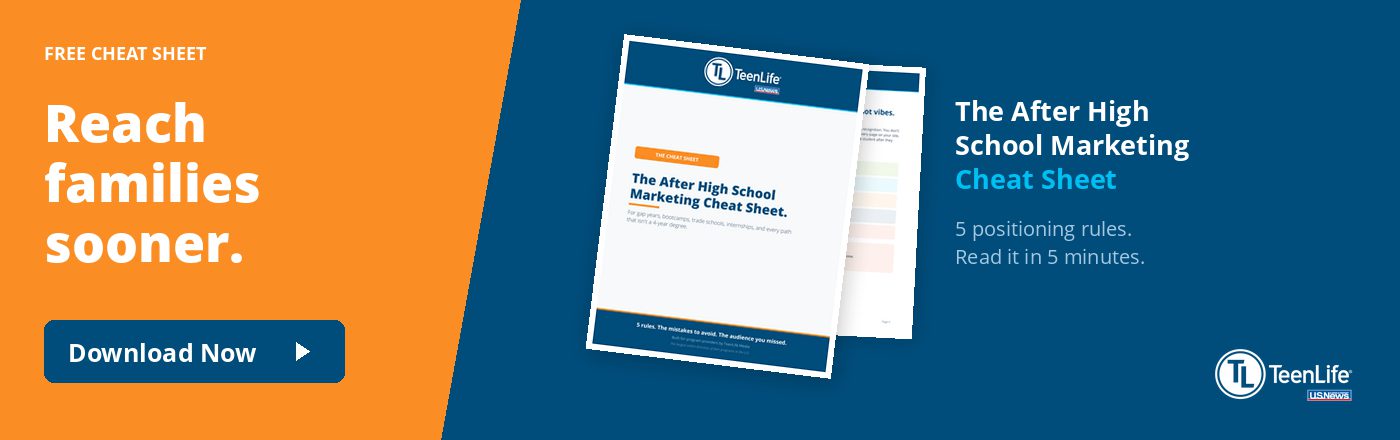
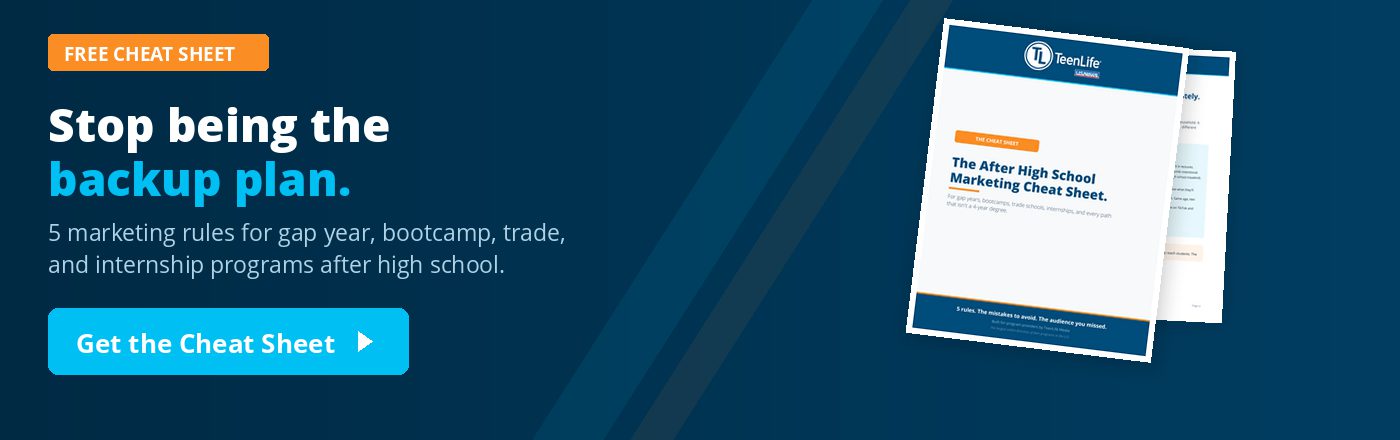
The shifts above are the strategy. Putting them into practice takes specifics: the exact phrases to swap out of your copy, the single outcome metric that matters most for each program type, the four messaging traps that quietly kill conversions, and the channels that reach families during the exploration window.
We packaged all of it into a free resource built specifically for this audience: The After High School Marketing Cheat Sheet. It covers gap year, bootcamp, trade school, internship, and community college providers, and you can read it in about five minutes.
How TeenLife helps you reach the right families
TeenLife Media connects program providers with families who are actively researching what comes after high school. Through directory listings, targeted advertising, dedicated email campaigns, and the Pathways After High School Guide and Fair, TeenLife puts your program in front of parents, students, and counselors during the exploration window, while your message can still shape the decision.
FAQ
What's the biggest mistake providers make when marketing alternatives to college? Positioning against college instead of toward an outcome. When you describe your program as "an alternative," you keep the 4-year degree as the reference point and frame yourself as the lesser choice. Lead with the specific result your program delivers instead.
When should we start marketing to high school families? Earlier than most providers do. By senior spring, most families have settled their plans. Sophomore and junior year is the exploration window, when students and parents are still forming opinions, which makes it the best time to reach them.
Should we market to students or their parents? Both, but separately. Students and parents want different things and worry about different things. Build distinct messaging for each, and deliver it on the channels where each audience actually spends time.
What kind of proof do families want to see? Concrete outcomes. Placement rates, time to credential, starting salaries, and credit transfer rates carry far more weight than inspirational language. Specific, sourced data is the most persuasive thing you can put in front of a cost-conscious parent.

Dustin Silvaer
Dustin Silvaer is a Digital Marketing Manager at TeenLife.com, where he leads paid advertising, marketing automation, and partnership development for one of the largest teen program directories in the country.



Organization with listings on TeenLife? Login here
Register for Free
We’re here to help you find your best-fit teen-centered academic and enrichment opportunities.
Forgot Password
"*" indicates required fields