


How to Market an Arts Program: A 2026 Guide to Filling Auditions
Posted June 4, 2026, 12:58 pm by
Most marketing advice for teen programs assumes you run a summer camp, a STEM intensive, or an academic enrichment program. If you run a performing or visual arts program, that advice falls apart fast.
Knowing how to market an arts program means working with three differences no other program category faces. Your enrollment funnel has an extra step: the audition or portfolio review. Your biggest conversion barrier isn't price or schedule, it's a parent quietly wondering whether an arts career is real. And the students you want to reach scatter across different platforms depending on whether they dance, paint, act, or edit film.
This guide covers five strategies built for the way arts families actually research and decide.
Why marketing an arts program is different
Three things make arts program marketing its own discipline.
First, the funnel is longer. A typical program moves from interest to application to acceptance to enrollment. Arts programs add an audition or portfolio review in the middle, and that extra step is where most interested students quietly disappear.
Second, the core objection is emotional, not logistical. Families considering a test-prep or STEM program rarely ask whether the field is viable. Families considering an arts program almost always do, even if they never say it out loud.
Third, your audience fragments by discipline. A teen serious about classical violin lives in a different corner of the internet than one building a film reel or a digital art portfolio. One message on one channel won't reach them all.
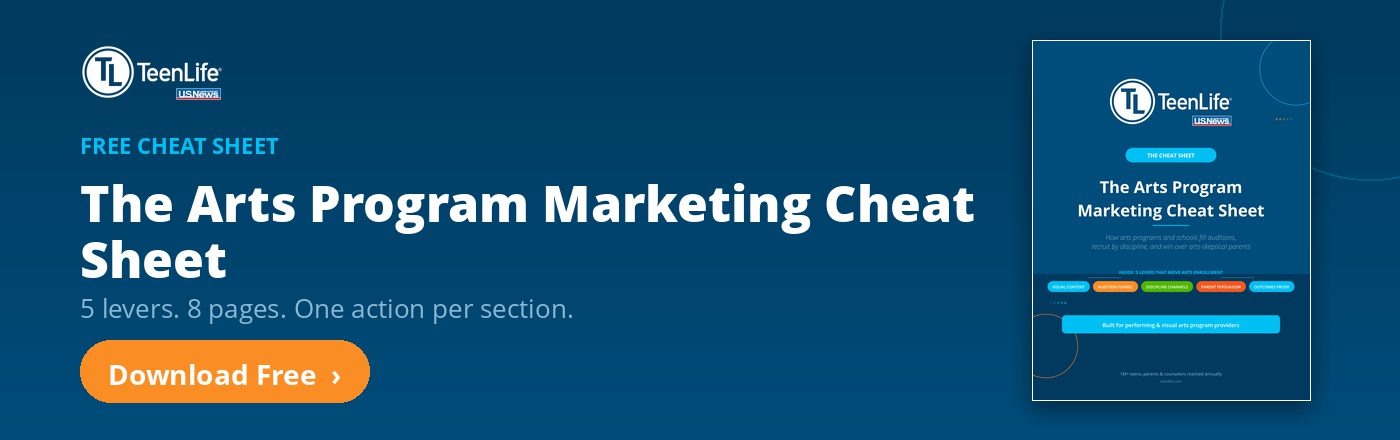
Five strategies to market your arts program
Here are the five levers that move enrollment for arts programs specifically. Start with whichever you're weakest on.
1. Put the visual content your students already make to work
Arts programs sit on a marketing asset other program categories would pay for: students who produce compelling visual work every single day. Rehearsals, critiques, studio sessions, performances. Most programs barely use it.
This matters because the platforms teens actually use are video and image first. Pew Research found that 90% of U.S. teens use YouTube and 63% use TikTok, with majorities on these platforms daily. A program posting a steady stream of real studio footage will out-recruit one posting polished brochures nobody watches.
You don't need a production budget. A 30-second phone clip of a student at work, captioned well, often beats an expensive promo video. The harder question is what to film and where each type of content belongs.
2. Map your audition funnel and find the leak
Because arts programs add an audition or portfolio step, you have one more place to lose people than other programs do. It's usually the biggest leak.
Students get excited, start an application, then stall when they hit “submit a portfolio” or “schedule an audition.” They don't quit because they lost interest. They quit because they don't know what to prepare or what you're looking for.
The fix is rarely more top-of-funnel marketing. It's clarity at the audition step. Tell prospective students exactly what to expect before they start the application, not in the middle of it. Walk your own application like a nervous 16-year-old and note every place you had to guess.
3. Recruit by discipline, not in general
A dancer and a filmmaker do not live in the same place online, and the same people don't influence them. Generic “we run Instagram and Google ads” marketing treats them as one audience. They aren't.
Teen platform habits back this up. YouTube is nearly universal, but how a student uses it depends entirely on their craft. A classical musician is watching technique tutorials. A digital artist is on YouTube and portfolio sites. A dancer is on TikTok and Instagram, often guided by a private studio teacher who shapes where they apply.
Directories are part of this too. Families researching arts programs browse them by discipline, so being listed where they're already looking, like the TeenLife Guide to Performing & Visual Arts, puts you in front of intent-driven searchers across every craft.
Pick your two strongest disciplines and audit whether your marketing spend actually reaches where those students spend time. Most programs discover they're advertising into the wrong rooms.
4. Answer the “is this a real career?” objection before they ask
This is the objection that kills arts enrollment, and most programs never address it directly. Families get excited at an open house, then go home and talk themselves out of it because a parent can't picture the career on the other side.
The data is on your side, so use it. The arts and cultural sector added more than $1.1 trillion to the U.S. economy in 2022, and the following year it grew faster than the overall economy and accounted for nearly 5.4 million wage-and-salary jobs.
Arts graduates do work in their fields, too. The Strategic National Arts Alumni Project found that 87% of arts and design alumni ages 18 to 64 were in the workforce, and that 61% were primarily employed in an arts-related field within five years of graduating, with 81% reporting high career satisfaction.
You don't need to oversell. You need to put real numbers in front of parents so the career question has an answer, then back it with your own program's placement record.
5. Tell outcome stories with specifics
“Our graduates go on to do amazing things” is the weakest sentence in arts marketing. It's everywhere, which means it persuades no one.
Specifics convert. A named alumnus, the specific thing your program helped them do, and where they are now beats any general claim about success. “Our students grow as artists” says nothing. “A 2024 graduate built a portfolio here, applied to three design schools, and is now on scholarship at one of them” says everything.
The pattern is always the same: a real name, a concrete action, a verifiable result. Start collecting these from recent alumni now, while they still answer your emails.
Where to start
You don't have to do all five at once. If your auditions are under-attended, start with the funnel. If parents go quiet after open houses, start with the career objection. If your social media is a ghost town, start with the visual content you already have on someone's phone.
Pick one lever, take one action this week, and measure what changes.
Get the full playbook
We pulled the specifics into a free resource for arts program providers: the content types and where each belongs, the full audition-funnel diagnostic, a channel map for eight disciplines, the five parent objections with direct answers, and the outcome-story formula.
Get the Arts Program Marketing Cheat Sheet. It's free, eight pages, and built for exactly this.
Frequently asked questions
How do arts programs attract students?
The most effective arts programs lead with the visual work their students already produce, recruit on the specific platforms each discipline uses, and address the career-viability question parents have head-on. Polished brochures and generic ads underperform real studio content and discipline-specific targeting.
What is the best way to recruit students for a pre-college arts program?
Map your full enrollment funnel, including the audition or portfolio step, and find where prospective students drop off. For most arts programs the biggest leak is between starting an application and submitting an audition, usually because students don't know what to prepare. Fixing that clarity gap recovers more enrollment than additional top-of-funnel advertising.
How do you market an arts program to parents?
Parents weigh arts programs against a quiet worry about career outcomes. Address it directly with credible data on the creative economy and arts-graduate employment, then back it with your own program's specific placement record. Vague success claims raise the worry instead of resolving it.

Dustin Silvaer
Dustin Silvaer is a Digital Marketing Manager at TeenLife.com, where he leads paid advertising, marketing automation, and partnership development for one of the largest teen program directories in the country.



Organization with listings on TeenLife? Login here
Register for Free
We’re here to help you find your best-fit teen-centered academic and enrichment opportunities.
Forgot Password
"*" indicates required fields